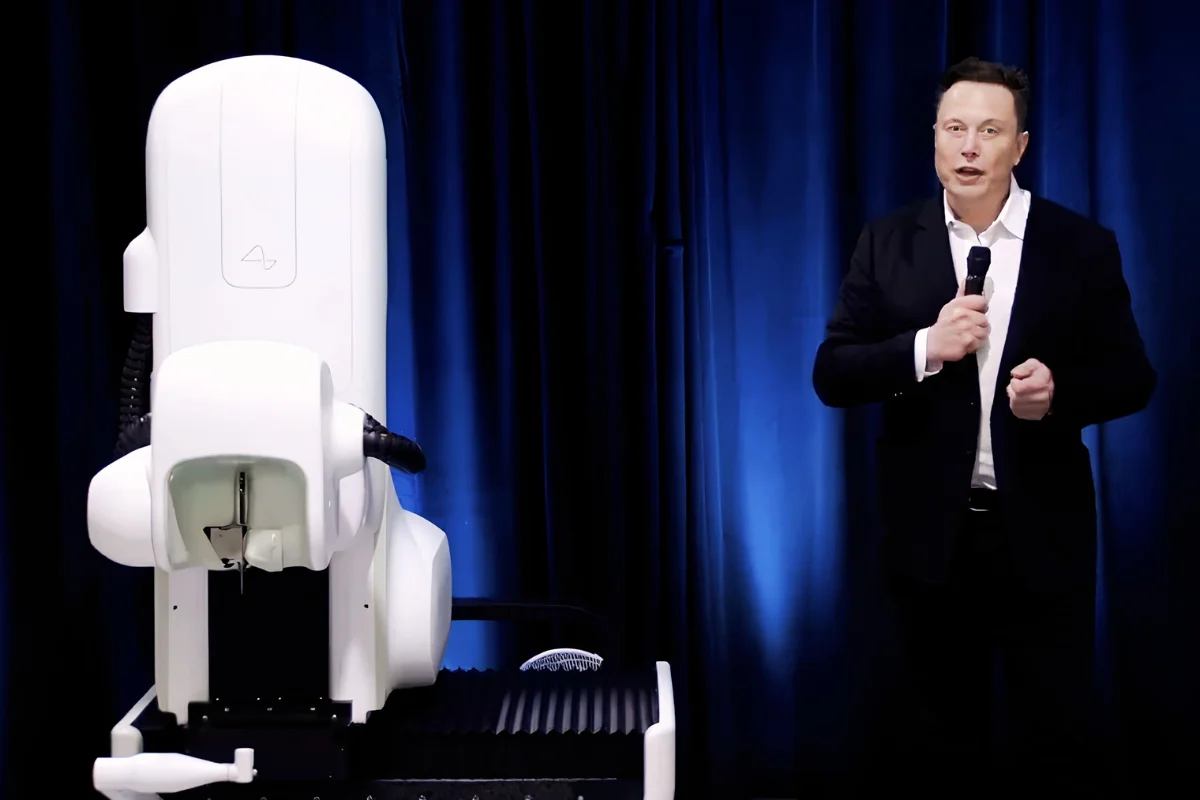
Can humans one day upload their minds into robots? The idea sounds like science fiction, but Musk did make a version of that prediction at Tesla’s 2025 annual meeting. Musk said Neuralink might eventually create an “approximate snapshot” of a person’s mind and upload it to an Optimus robot body, but it may be “ less than twenty years” away.
What makes the claim newsworthy is not that the technology exists now. Neuralink’s real-world progress is still much narrower and more medical. Neuralink’s implant is being tested to help people with severe paralysis, and the first patient used it to move a cursor, browse the internet, play video games and post on social media.
Musk makes the prediction at Tesla’s shareholder meeting
The gap between controlling a cursor and copying a human mind is enormous. A Georgian neuroscientist wrote in 2025 that mind uploading may be theoretically possible one day, but also added that researchers have “barely begun to understand the brain” and that, right now, “we’re nowhere close.” In simple terms, today’s brain-computer interfaces can capture limited signals. They do not preserve memory, personality, self-awareness or consciousness in any complete way.
Reuters on Neuralink’s first human implant
So the headline claim is real, but it should be understood for what it is: a long-range vision, not a near-term breakthrough. Musk is talking about a future where Neuralink and Tesla’s Optimus robot might merge into something far beyond today’s technology. For now, though, Neuralink remains a developing medical device platform, not a tool for digital immortality.